A lot of business owners use "ISMS" and "ISO 27001" as if they're the same thing. They're not. An ISMS is the actual system you build inside your business to manage information security. ISO 27001 ISMS certification is the independent proof that the system you built actually works.
What an ISMS Really Is
ISMS stands for Information Security Management System. It's not a piece of software. It's the full set of policies, processes, and controls a business uses to protect its data — who can access what, how risks get reviewed, what happens when something goes wrong.
Think of it less like a product and more like a filing system for how your business handles security decisions. Some businesses already do most of this informally. An ISMS just makes it documented, consistent, and something you can actually prove to someone else.
The standard itself doesn't tell you exactly which tools to buy or which software to run. It tells you what questions your business needs to have answered — who owns which risk, how often controls get reviewed, what happens when a laptop goes missing. The specifics are yours to define, as long as they hold up under scrutiny.
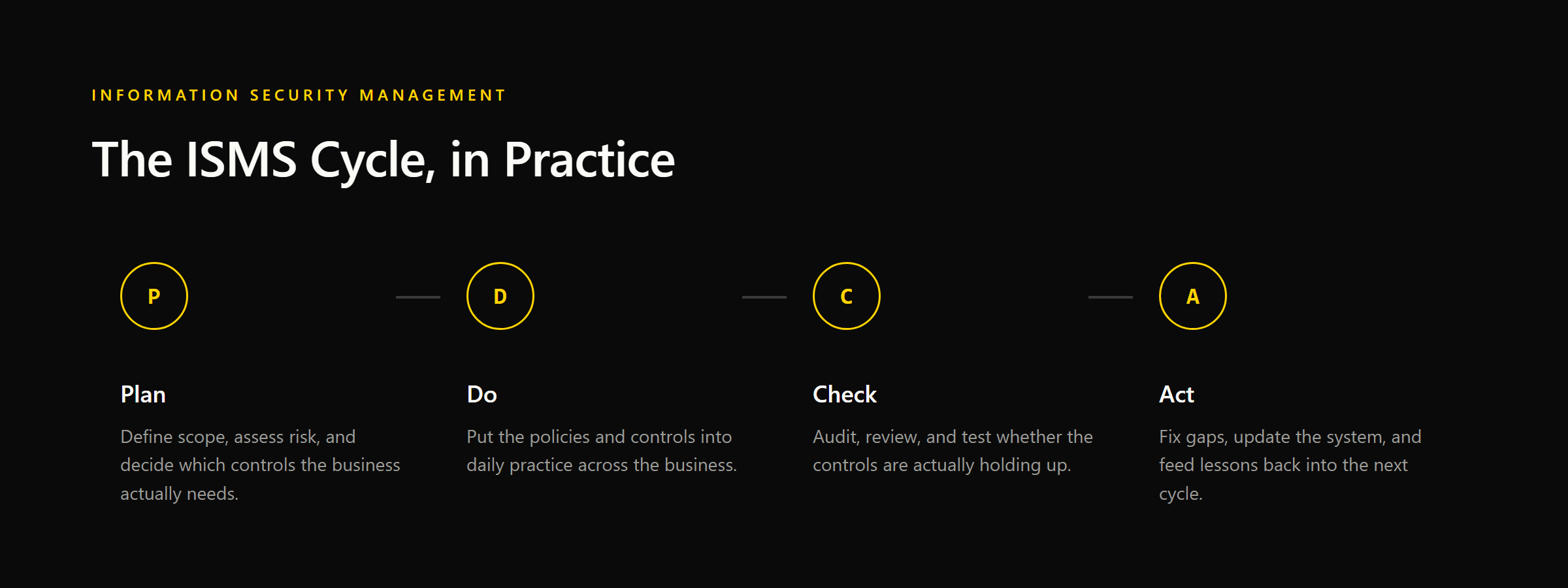
How ISO 27001 ISMS Certification Actually Works
Getting certified isn't a single test. It's a sequence, and skipping steps is exactly what causes businesses to fail their first audit.
- Define the scope — decide which parts of the business, systems, and data the ISMS actually covers.
- Run a risk assessment — identify where information could be lost, stolen, or exposed, and how likely each risk is.
- Put controls in place — the specific policies and technical measures that address the risks you found.
- Stage 1 audit — an auditor reviews your documentation to check the ISMS is designed properly.
- Stage 2 audit — the auditor checks the ISMS is actually being followed in practice, not just written down.
- Certification — once both stages pass, you're certified, typically for three years.
- Surveillance audits — shorter annual check-ins to confirm the system is still being maintained.
What Auditors Actually Check
Auditors aren't grading your paperwork for style. They're checking whether the ISMS reflects what actually happens day to day.
- Whether staff can explain the security policies that apply to their own role.
- Whether access to sensitive systems is actually restricted the way the documentation claims.
- Whether past incidents were logged, reviewed, and used to update the system.
- Whether risk assessments are current, not something written once and forgotten.
- Whether management actually reviews the ISMS on a regular schedule.
A business with thin documentation but strong daily habits often does better than one with a polished manual nobody follows. Auditors have seen plenty of businesses hand over a beautifully formatted policy folder and then fail the very first interview question, because the staff member being asked has never actually read it.
Who Actually Needs This
ISO 27001 ISMS certification isn't only for large enterprises with dedicated security teams. It's increasingly something smaller businesses get asked for directly.
- Businesses responding to tenders that list ISO 27001 as a mandatory or scoring criterion.
- Suppliers to larger companies that now require certified vendors as part of their own risk management.
- Businesses renewing cyber insurance, where certification can noticeably affect premiums.
- Companies that store or process client data and want a credible way to prove they take it seriously.
- Businesses that have had a security incident and want a structured way to prevent a repeat.
If none of these apply yet, certification might still be worth pursuing early — it's easier to build good habits before you're under pressure to prove them.
How Long It Takes and What It Costs
For a small to mid-sized business starting from scratch, three to six months is realistic if the work is prioritised. Businesses that already run tight security practices sometimes move faster. Cost depends heavily on scope and whether you bring in outside help for the gap assessment and audit prep, versus trying to build the ISMS entirely in-house.
The bigger cost, most businesses find, isn't the audit fee. It's the internal time spent documenting processes that were previously just "how things are done" rather than written down anywhere.
Audit fees themselves usually scale with the number of staff and sites in scope, since that affects how much the auditor needs to sample during Stage 2. A single-office business with thirty staff pays meaningfully less than a business spread across three states, even if both are pursuing the same certification.
Common Mistakes That Delay Certification
- Setting the scope too broadly, which multiplies the documentation and audit workload unnecessarily.
- Writing policies that don't match what staff actually do, which auditors catch quickly.
- Treating the risk assessment as a one-time exercise instead of something reviewed regularly.
- Waiting until right before the audit to start collecting evidence of ongoing compliance.
- Assuming a previous ISO 27001:2022 gap assessment covers everything, when it was only ever meant to flag the starting gaps.
Getting Started on ISO 27001 ISMS Certification
Most businesses shouldn't start with the audit. They should start with an honest look at where they currently stand. A self-assessment against a recognised framework gives you a baseline before you commit to a formal certification timeline.
From there, our compliance and audit team can walk the gap between where you are and where ISO 27001 ISMS certification actually requires you to be, and build a realistic plan to close it. If you want the background first, our earlier posts on what an ISMS actually involves and the ISO 27001 gap assessment are worth reading before you start.
Frequently Asked Questions
What's the difference between an ISMS and ISO 27001 certification?
An ISMS is the system you build internally; ISO 27001 certification is the independent confirmation that the system meets the standard.
How long does ISO 27001 ISMS certification take?
Three to six months is typical for a small to mid-sized business starting from scratch, depending on how prepared the business already is.
Do we need a gap assessment before certification?
It's strongly recommended — it shows you exactly where your current practices fall short before you commit to a certification timeline.
Does certification expire?
Yes, certification typically runs for three years, with shorter surveillance audits each year in between to confirm the system is still being maintained.
Can a small business realistically get certified?
Yes — scope is flexible, and a tightly defined scope often makes certification more manageable for a smaller business than a sprawling one.
What's the most common reason businesses fail their audit?
Documentation that doesn't match what actually happens day to day — auditors test practice, not paperwork.